
How Much Sunscreen Should I Use? A Dermatologist-Backed Guide
Most people use sunscreen wrong, and the most common mistake is using too little of it. According to the American Academy of Dermatology, most adults apply only 25 to 50 percent of the amount needed to actually deliver the SPF on the label. That means a bottle labeled SPF 50 might be delivering closer to SPF 15 to 25 on the skin.
The good news is that the fix is simple. You just need to know how much sunscreen to use, where to put it, and how often to reapply. Here is what the research and dermatologists actually recommend.
The Short Answer: How Much Sunscreen to Use
For most adults, the AAD recommends about one ounce of sunscreen to cover all exposed skin. That is roughly the amount needed to fill a shot glass.
For the face, ears, and neck, the recommendation is about half a teaspoon, which is also the amount that fits along the length of three fingers. This is known as the three-finger rule.
Reapply every two hours, and immediately after swimming, sweating, or toweling off.
That is the short version. The rest of this guide breaks it down by body area, explains the three-finger rule in more detail, and answers the questions people actually ask.
Why Most People Apply Too Little
Sunscreen is tested in labs at a standardized application rate of 2 milligrams per square centimeter of skin, set by the FDA. That is the amount required to deliver the SPF printed on the bottle.
In real life, almost nobody applies that much. Research published in the Journal of the American Academy of Dermatology shows real world application typically lands at 0.4 to 0.8 milligrams per square centimeter. That is roughly a quarter to half of the recommended amount.
The reason matters. Sunscreen does not work in proportion to how much you apply, it works as a multiplier. Cutting the amount in half does not cut protection in half, it cuts it disproportionately more. A study cited by the Skin Cancer Foundation showed that applying half the recommended amount of an SPF 50 product can drop effective protection to roughly SPF 7.
That is why how much sunscreen you use matters as much as which sunscreen you choose.

How Much Sunscreen to Use on Your Face
The AAD recommends about half a teaspoon of sunscreen for the face, ears, and neck combined. The easiest way to measure this without a spoon is the three-finger rule.
The Three-Finger Rule
Squeeze a line of sunscreen along the entire length of your index, middle, and ring fingers. Combined, that is roughly half a teaspoon, which is the amount dermatologists recommend for your face, ears, and neck.
If you are using a mineral sunscreen, you may notice it takes a little more effort to rub in evenly. That is normal. Mineral sunscreens sit on the skin rather than absorbing into it. For face application where precision matters, a tinted mineral lotion can help you see exactly where you have applied.
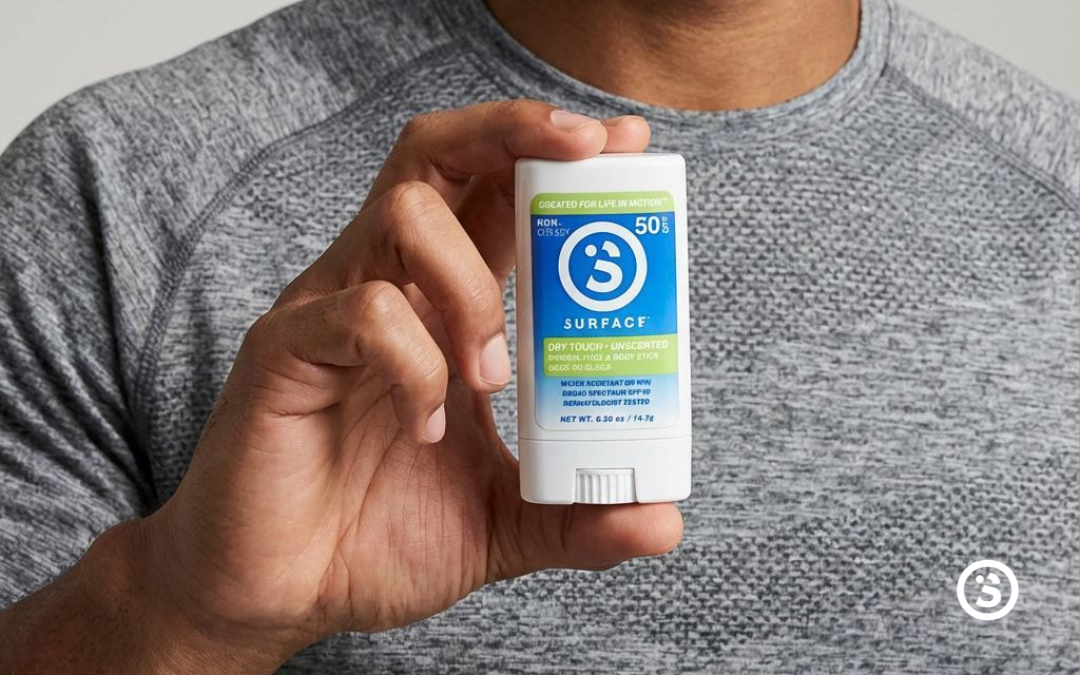
A mineral face stick is another option for targeted areas like the nose, ears, and tops of the cheekbones.
Do Not Forget These Spots
The face is more than the face. To get full protection, extend your sunscreen to:
- Ears, especially the tops and behind
- Hairline and exposed scalp
- Eyelids and under-eye area, if your formula is gentle enough
- Lips, with an SPF 30+ lip balm
- Back and sides of the neck
These are the spots dermatologists see sun damage most often, because they are the spots most people skip.
How Much Sunscreen to Use on Your Body
For full-body coverage, the one ounce or shot glass rule still applies. If you want a more precise breakdown, dermatologists often use the teaspoon rule for the body, which divides the body into zones:
- One teaspoon for the face and neck
- One teaspoon for each arm
- Two teaspoons for each leg
- One teaspoon for the front torso
- One teaspoon for the back
That works out to roughly nine teaspoons total, which is just over one ounce. Adjust up if you are taller, larger, or covering more skin than average.
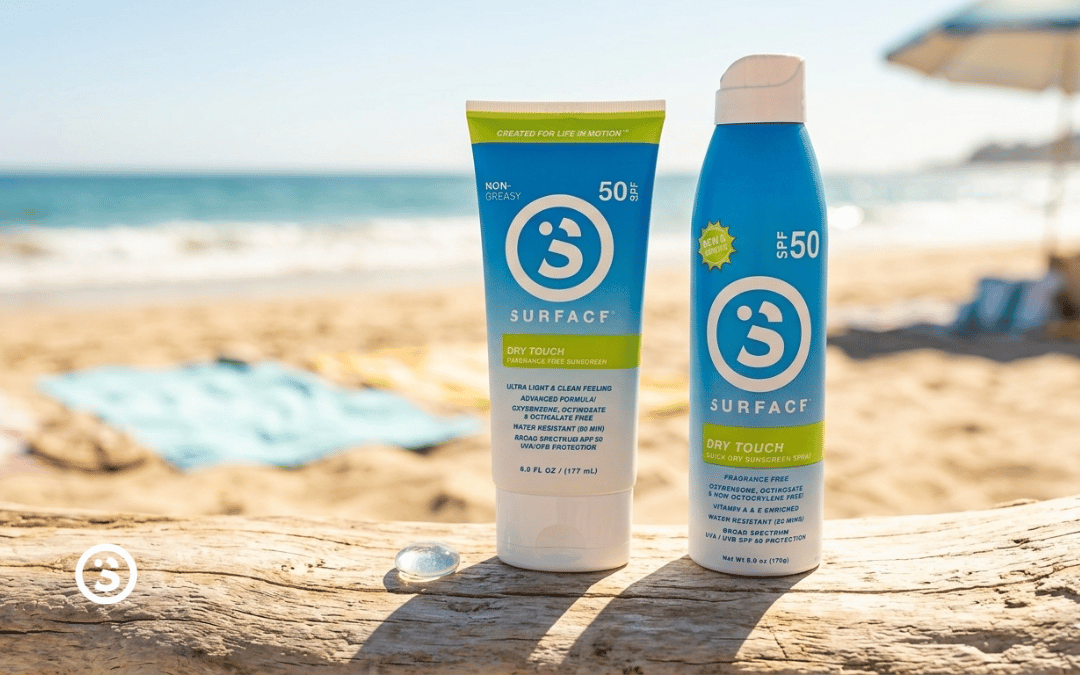
For body application, a lightweight lotion that absorbs quickly is the easiest way to hit the recommended amount without it feeling heavy. The SPF 50 Dry Touch Sunscreen Lotion 6 oz is designed for exactly that. If you are reapplying during an active day, the SPF 50 Dry Touch Continuous Spray 6 oz makes a full second application much faster, as long as you rub it in.
For more on whether spray or lotion is the right choice for your situation, see our breakdown of spray sunscreen versus lotion.
How Often to Reapply Sunscreen
The AAD recommends reapplying sunscreen every two hours, and immediately after swimming, sweating, or toweling off. There are no exceptions for higher SPFs. SPF 50 and SPF 70 do not last longer than SPF 30, they just provide slightly more protection per application.
Water-resistant sunscreens, including all Surface formulas, hold up for 80 minutes of swimming or sweating before reapplication is needed. After that, reapply.
If you towel off, reapply even if the bottle has not run its 80 minutes. Toweling removes sunscreen along with water.
Sun Protection Made Easier
Knowing how much sunscreen to use is half the battle. The other half is using a sunscreen you actually want to apply often enough to do its job.
Every Surface formula is broad spectrum, water resistant for up to 80 minutes, reef friendly, microplastic free, and formulated without oxybenzone or octinoxate. The Dry Touch collection is built for daily and active use with a fast absorbing, non-greasy finish. The Mineral collection uses non-nano zinc oxide for sensitive skin and precise face application.
For a deeper look at how mineral and non-mineral formulas compare, our guide to mineral versus non-mineral sunscreen walks through which works best for which situation.
The most effective sunscreen is the one you actually use, in the amount that actually works.

Frequently Asked Questions About How Much Sunscreen to Use
Is a pea-sized amount of sunscreen enough for the face?
No. A pea-sized amount is well under what is needed to deliver the SPF on the label. The standard recommendation is about half a teaspoon, or three finger lengths, for the face, ears, and neck combined.
Can you use too much sunscreen?
Not in a way that affects safety. Applying more sunscreen than the recommended amount does not provide significantly more protection past a certain point, but it will not harm your skin either. The more common issue is using too little, not too much.
Should you rub sunscreen in?
Yes. Whether you are using a lotion, spray, or stick, the sunscreen needs to make even contact with the skin to deliver its rated SPF. Rubbing in helps spread the product evenly and reduces missed spots, especially with sprays.
What is the three-finger rule for sunscreen?
The three-finger rule is a simple way to measure how much sunscreen to use on your face. Squeeze a strip of sunscreen along the length of your index, middle, and ring fingers. That works out to roughly half a teaspoon, which is the amount dermatologists recommend to cover the face, ears, and neck.
Does a higher SPF mean you need less sunscreen?
No. The amount you apply is the same regardless of SPF. SPF measures the level of UVB protection per application, not how long the protection lasts or how much you need to use.
How much sunscreen do you need for an all-day beach trip?
A reasonable rule is one ounce per application, every two hours. A standard day at the beach typically uses about four to six ounces per person. That is why a six-ounce bottle does not last as long as people expect when used correctly.
Should you apply sunscreen before or after moisturizer?
Apply sunscreen after moisturizer and before makeup. Wait about a minute between moisturizer and sunscreen so the moisturizer has time to absorb. Sunscreen needs to be the last skincare layer on bare skin to deliver its rated SPF.
Why does sunscreen only last two hours?
Sunscreen breaks down with UV exposure, sweat, water, and friction from skin contact and clothing. After about two hours of sun exposure, the active ingredients have degraded enough that protection drops significantly. This is true even if you have not been swimming or sweating.