
Your Morning Commute Is Aging Your Skin!

Most people think of sun damage as a beach-day problem. A long weekend in the sun, a pink nose, a peeling shoulder. Something that happens on vacation, not on a Tuesday.
But the most consistent source of UV exposure in your life is not your vacations. It is your commute.
Whether you drive, take the train, ride a bike, or walk to a bus stop, your morning routine is quietly exposing your skin to ultraviolet light, five days a week, year after year.
Here is what is actually happening on your way to work, why it matters for how your skin ages, and how to protect yourself without overhauling your morning.
Why Daily Commute UV Adds Up
Sunlight contains two types of ultraviolet radiation that affect your skin. UVB is the shorter wavelength that causes sunburn. UVA is the longer wavelength that does not burn, but penetrates more deeply into the skin. UVA is the primary driver of visible aging, including wrinkles, fine lines, sagging, and dark spots. It also contributes to skin cancer risk.
A key point that often gets missed: UVA is present from sunrise to sunset. While UVB peaks around midday, UVA stays at meaningful levels all day long, including during typical morning and evening commute hours. You do not need to feel warm, squint at a bright sky, or get a tan to accumulate UVA damage.
Research estimates that up to 80 percent of visible facial aging is caused by UV exposure. Every day, incidental exposure, the kind you pick up walking to the train, sitting near a window, or driving to work, also accounts for far more of that lifetime dose than occasional sunny vacations.
A commute is the perfect example of incidental exposure. It happens on repeat. It goes unnoticed because no single dose feels significant. And it affects your face, neck, and hands, which are the areas where visible aging shows up first.

How Your Commute Affects Your Skin, by Mode
Every commute carries UV exposure, but the way that exposure reaches your skin depends on how you get to work. Each mode has its own blind spots.
If You Drive
A car is not the sun-proof bubble many people assume it is. Windshields are made of laminated glass and block most UVA. Research on dozens of vehicles has found that windshields block an average of around 96 percent of UVA rays, while driver-side windows block only about 71 percent. Side and rear windows are typically tempered glass, which blocks UVB but lets a meaningful share of UVA through.
That is why dermatologists regularly see more sun damage, wrinkling, and even skin cancer on the left side of drivers' faces and arms in the United States. The driver-side window, day after day, is the culprit. Standard window tint does not necessarily fix this. It is designed to reduce glare and heat, not specifically to block UVA.
If You Take the Bus or Train
Public transit feels like shelter, but most bus and train windows behave similarly to car side windows. They block UVB reasonably well, but allow significant UVA to pass through. If you ride in a window seat during daylight hours, the side of your face and the arm nearest the window are getting exposure, even when the glass feels cool to the touch.
Transit commutes often include outdoor segments too: walking to the stop, waiting on an open platform, transferring between lines. Those minutes in direct sunlight, repeated every workday, are where the bulk of UVB exposure happens for transit riders.
If You Walk
Walking commuters get the most direct exposure of any group. There is no glass, no shade, no filter between your skin and the sun. UVA and UVB reach you in full. Even a short walk of 10 or 15 minutes each way means 20 to 30 minutes of direct sun on your face, neck, and hands, five days a week.
Sidewalks, concrete, and nearby buildings add another factor: reflected UV. Hard urban surfaces bounce additional UV light up at you, including onto areas a hat might normally shade. That is part of why city pedestrians often show signs of aging on the lower face and under the chin, not just on the forehead and cheeks.
If You Bike
Cyclists tend to wear less skin coverage than walkers, with short sleeves, shorts, and exposed forearms and calves, and they are outside for longer because they travel further. Research on daily cyclists has flagged them as a higher-risk group for cumulative sun damage and skin cancer for this reason.
Riding along water, through open streets, or across bridges also introduces reflected UV from pavement and occasionally from water. Wind can make it feel cool even when UV is strong, which tends to trick riders into skipping sunscreen on mild days.

Why Commute UV Is So Easy to Overlook
Beach sunscreen is a habit because the sun feels obvious. A commute rarely feels like sun exposure at all. There is no burn, no sweat, no squinting at the open sky. That is exactly why it flies under the radar.
A few things make commute exposure particularly sneaky:
- It happens on repeat, at roughly the same time every weekday
- UVA stays strong throughout morning and late-afternoon hours
- It affects the same areas of skin every time, so damage concentrates
- Cloudy days still transmit up to 80 percent of UV, so overcast is not a pass
- Cooler seasons feel safer, but UVA exposure is still year-round
Short commutes count too. Fifteen minutes each way, five days a week, is more than 100 hours of exposure a year. Over a decade, that is more time in the sun than many people spend on actual beach vacations.
Who Gets Hit Hardest
Anyone with a daily commute is accumulating sun exposure, but some situations concentrate the risk:
- Drivers with routes longer than 20 minutes, especially east-west routes where the sun sits on a side window
- Rideshare, delivery, and field workers who are on the road most of the day
- Walking and biking commuters in sunny or high-elevation cities
- Transit riders who frequently sit in window seats during daylight hours
- Parents doing daily school drop-offs, sports runs, and errands on foot or by car
- Anyone who commutes during daylight hours in spring and summer, when UV is stronger earlier and later
No skin tone is exempt, either. Darker skin has more natural melanin and burns less easily, but UVA damage, dark spots, and skin cancer still happen, and are often diagnosed later because they are not expected.

How to Protect Your Skin on the Commute
The fix does not require changing how you get to work. It is a small set of habits that plug into your existing routine.
Apply Broad-Spectrum Sunscreen Before You Leave
A broad-spectrum sunscreen protects against both UVA and UVB, which is exactly what commute exposure calls for. Apply it to your face, neck, ears, and the backs of your hands before you walk out the door. If you wear short sleeves, extend it down your forearms. Reapply every two hours if you are outside for a full commute, or any time you are doing outdoor legs between transit or meetings.
For something you will wear every weekday, the texture of the sunscreen matters as much as the SPF number. A formula that feels heavy, greasy, or sticky is one you will eventually stop using. A lightweight, fast-absorbing sunscreen is far easier to make part of your daily routine.
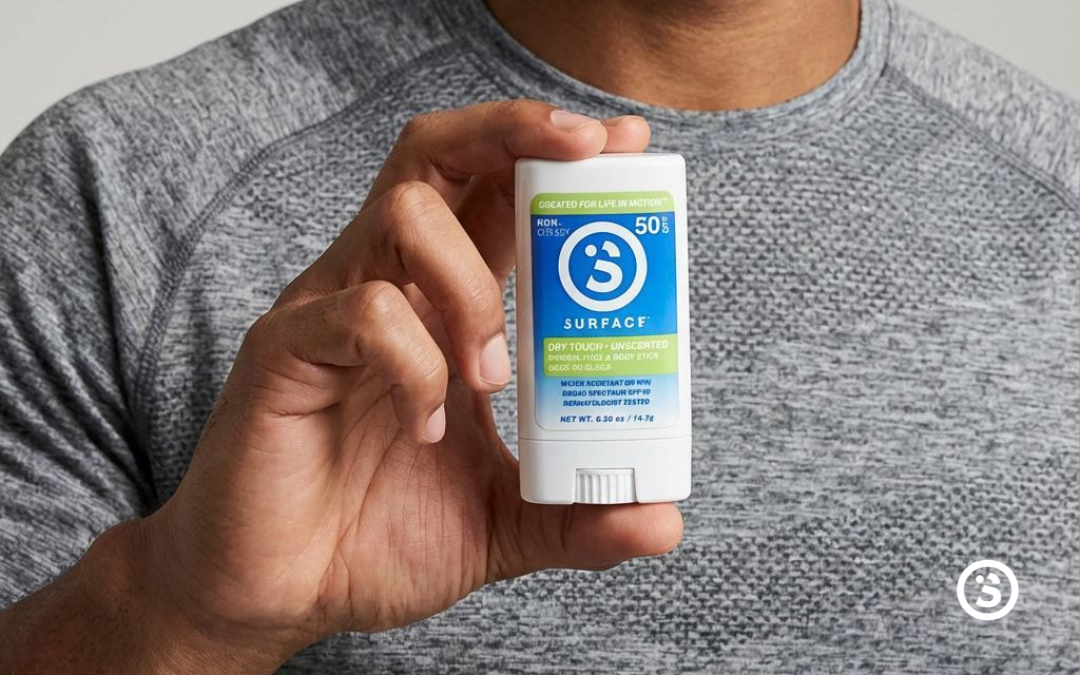
For the mornings you rush out the door, a Surface Sunscreen face stick lives well in a bag, backpack, or glove box. No spilling, no mess on your fingers, no excuse to skip it. A quick swipe across your face, neck, and the backs of your hands on the walk to the car, train, or bus, and you are protected before your commute even starts.
Dress With UV in Mind
Clothing is one of the most reliable forms of sun protection, and it does not need reapplication. A few simple upgrades:
- A wide-brimmed hat or structured cap for walkers and cyclists
- UV-blocking sunglasses, ideally wraparound for cyclists
- A light long-sleeve layer or UPF shirt for biking, long walks, or open transit platforms
- Gloves or back-of-hand coverage for drivers and cyclists
Make It a Daily, Not Sunny-Day, Habit
The most effective sunscreen is the one you actually use. Pair daily sunscreen application with an existing routine, like after brushing your teeth, before grabbing your keys, or while your coffee cools, so it becomes automatic.
You are not trying to block the sun entirely. You are trying to trim the cumulative dose your skin absorbs every weekday for the next several decades.
Sun Protection Built for Life in Motion
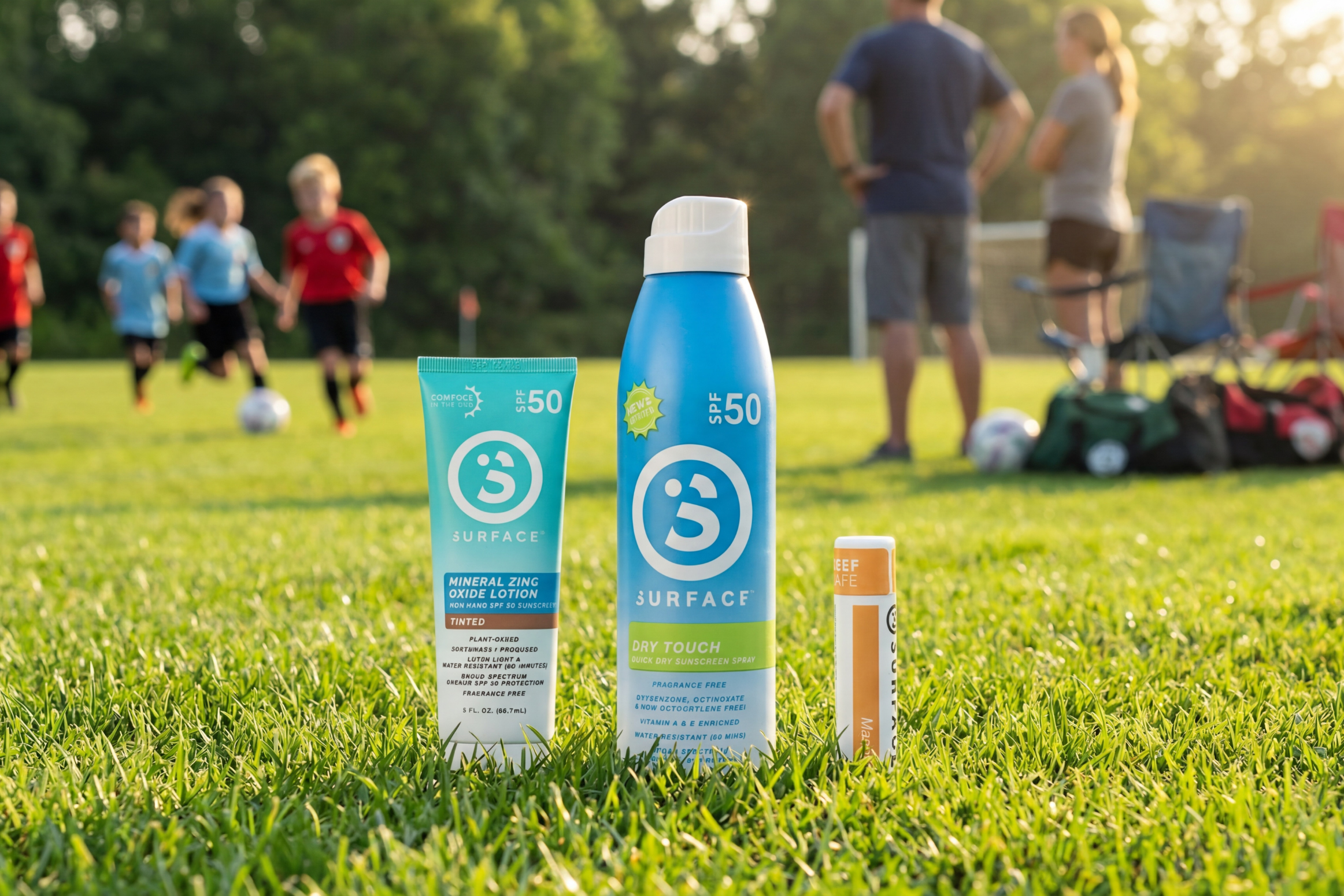
Surface Sunscreen is made for exactly these everyday moments, including the ones that do not feel like sun exposure. Every formula delivers broad-spectrum UVA and UVB protection with 80 minutes of water and sweat resistance, so it holds up through a morning commute, a walk at lunch, and an afternoon pickup line.
The Dry Touch collection is designed to absorb quickly and leave no greasy residue, which makes it comfortable under makeup, easy on the hands and handlebars, and unlikely to interfere with glasses, helmets, or a commute bag. Formulas are reef-friendly, microplastic-free, and formulated without oxybenzone or octinoxate, so daily protection comes without unnecessary additives.
Your commute is not going away. The good news is that protecting your skin on the way there takes less effort than most people think, and the payoff is cumulative in the best possible way.

Commute and Skin Aging FAQs
Does a morning commute really age your skin?
Yes. UV exposure is cumulative, and research estimates that up to 80 percent of visible facial aging is caused by sun exposure. Most of that exposure comes from daily, incidental moments like commuting, not from occasional vacations. Over years of repeated exposure, a commute can contribute noticeably to fine lines, dark spots, and uneven tone.
Can you get sun damage while driving?
Yes. Windshields block most UVA and UVB, but car side and rear windows are made of tempered glass, which allows significant UVA to pass through. That is why dermatologists often see more sun damage and skin cancer on the side of the face and arm closest to the driver's side window in people with long daily commutes.
Do bus and train windows protect your skin from UV?
Most bus and train windows behave like car side windows. They block UVB effectively but allow meaningful UVA through. If you regularly sit in a window seat during daylight hours, the side of your face and arm nearest the window are receiving ongoing UVA exposure, even on cloudy days.
How much UV do you get walking to work?
Walking commuters receive direct, unfiltered UV exposure on their face, neck, and hands, along with reflected UV from sidewalks and buildings. Even a 10 to 15-minute walk each way adds up to roughly 100 hours of direct sun exposure per year, which is why daily sunscreen use is recommended for anyone who walks as part of their commute.
Is biking to work worse for your skin than driving?
Biking commuters tend to have more exposed skin and spend more time outdoors than drivers, which increases cumulative UV exposure. Research has identified frequent cyclists as a higher-risk group for sun damage and skin cancer. Sunscreen, UV-blocking sunglasses, and UPF clothing can significantly reduce that risk.
Do I really need sunscreen for a short commute?
Yes. Short daily exposures add up quickly. A 15-minute commute each way, five days a week, equals more than 100 hours of UV exposure per year. Because UVA damage is cumulative and often invisible in the short term, even brief daily commutes are worth protecting against with broad-spectrum sunscreen.
What sunscreen is best for everyday commuting?
A broad-spectrum sunscreen that protects against both UVA and UVB and feels comfortable to wear daily. A lightweight, non-greasy formula is more likely to be used consistently, which is what actually determines how well a sunscreen protects you. Surface Sunscreen Dry Touch formulas are designed for this kind of daily, on-the-go use.
Is UV a concern on cloudy days or in winter?
Yes. Up to 80 percent of UV radiation can pass through clouds, and UVA is present year-round. Cooler temperatures and overcast skies do not eliminate exposure, especially during daily commuting, which is why dermatologists recommend daily sunscreen as a year-round habit.
Does Surface Sunscreen work for daily commuting?
Yes. Surface Sunscreen is formulated for everyday life, including commuting, outdoor work, and sports. Formulas offer broad-spectrum UVA and UVB protection with 80 minutes of water and sweat resistance. Dry Touch formulas absorb quickly with no greasy residue, and every product is reef friendly, microplastic free, and free from oxybenzone and octinoxate.